QCI-CAT
Quantum-Secure Communication Tested in Practice in Austria
Austria’s Path to Quantum Communication
How can highly sensitive information be securely transmitted between government agencies, research institutions, and medical facilities? QCI-CAT did not merely examine this question in theory. As part of the project, an Austrian demonstration network was established, on which the consortium tested quantum-secure communication under real-world conditions.
QCI-CAT stands for “QCI: Proof of Concept – Secure Connectivity Austria.” The research project began on January 1, 2023, and ended on March 31, 2026. It was Austria’s national contribution to the European Quantum Communication Infrastructure, or EuroQCI for short.
A Building Block for Europe's Quantum Communications
With EuroQCI, the European Union is establishing a secure quantum communication infrastructure. It is designed to connect strategic locations via fiber-optic and satellite links and to provide additional protection for particularly sensitive data and critical infrastructure.
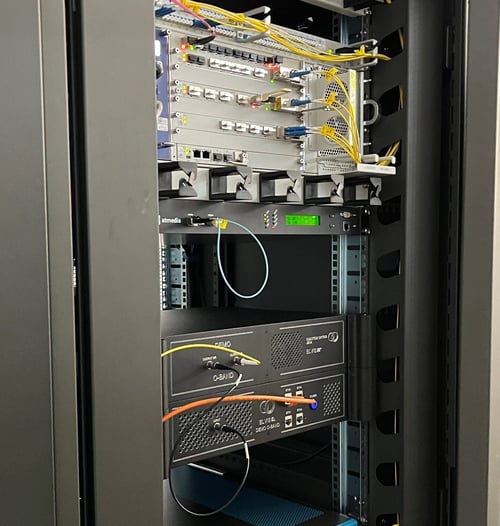
To this end, QCI-CAT has established a national QKD testbed in Austria. The project brought together research, industry, and public institutions, uniting various stakeholders: technology providers, integrators, operators, and future users. This enabled the participants to test the technology under conditions closely resembling real-world requirements.
A Quantum Network for Real-World Applications
The project resulted in a network spanning approximately 400 kilometers, connecting Vienna, Graz, and St. Johann im Pongau. The consortium used this network to test quantum-secure communication under real-world conditions—ranging from government communications and medical applications to video conferences. The focus was not only on quantum key distribution (QKD), but also on its interaction with post-quantum cryptography (PQC), key management systems (KMS), and other components of a secure communications infrastructure.
Through concrete demonstrations—including the exchange of sensitive genomic data, applications for government agencies, secure HSM backups, and secure audio and video communication—QCI-CAT has shown how quantum-secure technologies can be applied in practice. At the same time, the project partners have gained important insights into the operation, integration, and security of future quantum networks.
Our Expertise in QCI-CAT
dacoso supported QCI-CAT in transforming individual technologies into a functional network infrastructure. Our focus was on:
- security assessment of the systems and solutions deployed,
- collaborating on the Austrian EuroQCI architecture,
- the planning and procurement of network and QKD components,
- the installation and deployment of the infrastructure,
- commissioning and operating the testbed, including maintenance,
- the development of a planning and sizing document for a Europe-wide quantum network
What insights did the QCI-CAT project yield?
Headline
Add your content here.
What services do we currently offer?
We provide support for security assessments, the planning and integration of quantum-secure infrastructures, and the setup and operation of QKD environments.
Headline
Add your content here.
What are the benefits for companies and government agencies?
Headline
Add your content here.
The project has been completed. The work continues.
Three years of research, testing, and collaboration: QCI-CAT brought together people from academia, industry, and the public sector to test quantum-secure communication in a real-world network. The results are being incorporated into other projects under the EuroQCI initiative, such as BAT-QCI (establishing a quantum-secure connection between Vienna and Munich), CEQCI ( a cross-border QKD network between Austria, Slovakia, Hungary, and Romania), QCI-AT-CZ-PL (interconnection of the quantum networks of Austria, the Czech Republic, and Poland), QCIMED ( quantum communication between Italy, Austria, and Greece), and QUAPITAL, which is establishing a quantum-secure cloud connection between Vienna and Frankfurt. A total of 19 projects in 25 European countries are receiving funding. Together, they are driving the development of a Europe-wide, quantum-secure communications infrastructure and, step by step, turning the vision of a secure European quantum communication network into reality.
