DWDM experts
Over 20 years of experience in Layer 1 and DWDM networks - we know fiber optics down to the last detail.
Traditional encryption still reliably protects your data today - but this is precisely the problem: many companies and organizations are lulled into a sense of security, even though they should be taking action now. Powerful quantum computers will crack today's encryption methods in the future.
dacoso prepares your data transmission specifically for the post-quantum era. We analyze your existing DWDM infrastructure, evaluate suitable PQC solutions and integrate quantum-safe encryption smoothly and predictably into your existing systems.
Current encryption methods are considered reliable because they can hardly be cracked by conventional computers. This will change with powerful quantum computers: public key methods such as RSA and ECC will become vulnerable in the future.
The threat is already there: Attackers can already intercept and store sensitive data today in order to decrypt it later, as soon as the technical maturity for this is achieved. This "store now, decrypt later" scenario affects all information that needs to remain confidential for many years.
At the same time, the regulatory pressure to act is growing: NIS2, DORA, GDPR and BSI recommendations require long-term planning of the IT security strategy.
This raises three key questions for IT managers:

David Haas supports companies, authorities and critical infrastructures with questions relating to IT security, compliance and quantum-safe cryptography. In a joint discussion, you will clarify how well your current IT infrastructure is prepared for new cryptographic requirements and what concrete next steps make sense for you.
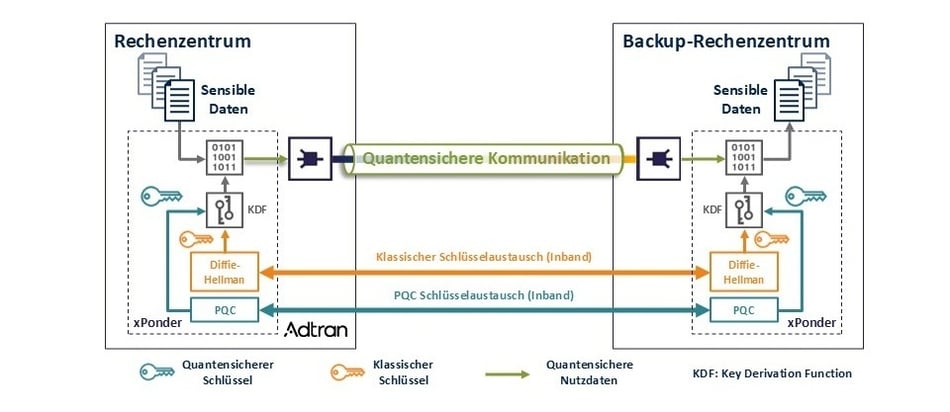
PQC does not replace traditional encryption overnight. A hybrid approach is particularly useful in critical infrastructures: existing procedures remain in use while quantum-safe cryptography is gradually added.
Traditional encryption |
Post-quantum cryptography |
|
Protection today |
Proven and currently reliable against classic attacks. |
Supplements existing procedures with protection against future quantum risks. |
Long-term confidentiality |
Critical for data that must remain protected for many years. |
Specially designed for data communication with long-term protection requirements. |
Risk from quantum computers |
Public key procedures such as RSA and ECC may become vulnerable in the future. |
PQC procedures remain resilient to quantum attacks. |
Integration into existing systems |
Already available in existing systems. |
Can be gradually integrated into suitable DWDM environments. |
Quantum-safe encryption prepares your data transmission for new attack scenarios and increases the long-term security of sensitive information.
Add your content here.
Suitable systems can be expanded in a targeted manner without completely replacing the existing infrastructure.
Add your content here.
In suitable systems, it is possible to start using an upgrade without major project delays or a complete change of infrastructure.
Add your content here.
High data throughput and low latency are maintained, so that secure data transmission is also practicable for critical connections.
Add your content here.
Requirements from GDPR, NIS2, DORA and BSI basic protection can be planned into the security strategy at an early stage.
Add your content here.
Early PQC integration reduces the risk of short-term mandatory conversions and expensive retrofits.
Add your content here.
PQC update:Adtran FSP 3000R7 |
Quantum security software update for your FSP 3000R7 including the necessary licenses. This makes your existing infrastructure fit for the future - usually without replacing the platform.
Your advantages:
✔ Future-proof through PQC ✔ Use of existing PQC-capable hardware ✔ License-based activation |
Add your content here.
PQC update:Adtran FSP 3000C |
We make your FSP 3000C PQC-capable through targeted software and configuration adaptations. This ensures that your network security remains guaranteed even in the post-quantum era.Hybridizationispossible by linking PQC with additional QKD keys.
Your advantages:
✔ PQC protection ✔ Usually no hardware changes necessary ✔ Customized adaptation |
Add your content here.
PQC update:Managed service |
If you have your systems operated and managed by us, we will ensure the continuous PQC security of your connections. This applies to the use of all Adtran FSP 3000 systems.
Your advantages:
✔ All-round carefree package ✔ Proactive security updates ✔ Monitoring & support included |
Add your content here.

At the dacoso Customer Briefing Center in Langen near Frankfurt am Main, we will show you how quantum-safe encryption is implemented in practice. Experience live how PQC can be integrated into existing infrastructures - and how your data transmission is specifically prepared for future quantum risks.
Our PQC solution can be flexibly combined with QKD (Quantum Key Distribution). This allows you to combine quantum-safe encryption with an additional method for key distribution and increase the security level of particularly sensitive data connections.
Over 20 years of experience in Layer 1 and DWDM networks - we know fiber optics down to the last detail.
Early specialization in encryption - directly where data is created: on the fiber.
Renowned companies, banks, carriers and authorities have been relying on our solutions for more than two decades.
Thanks to our 12 locations in the DACH region, our service technicians are always quickly on site. Decentralized spare parts warehouses also ensure fast recovery.
We are actively involved in major research projects on quantum-safe communication and incorporate this knowledge directly into your solution.
Together with leading partners in the industry, we design quantum-safe solutions for tomorrow.
Let us check now how well your data transmission is prepared for the post-quantum era - and create a reliable basis for decision-making for management, customers and partners.
Post-quantum cryptography, or PQC for short, refers to cryptographic processes that are designed to remain secure against attacks by powerful quantum computers. The aim is to protect sensitive data transmission in the long term - even in the post-quantum era.
PQC does not necessarily replace all existing security procedures immediately. In many scenarios, it makes sense to integrate PQC step by step, combining traditional encryption and quantum-safe cryptography.
RSA and ECC are based on mathematical problems that are very difficult for conventional computers to solve. Powerful quantum computers could attack these methods much faster in the future.
This is particularly critical for data with a long protection period: it can already be intercepted today and decrypted later as soon as the necessary computing power is available.
PQC is particularly relevant for organizations that need to protect sensitive data in the long term or are subject to high regulatory requirements. These include public authorities, KRITIS operators, data centers, financial companies, healthcare organizations and companies with confidential site networks.
Post-quantum security can become an important component of the security strategy, especially in the case of cross-location communication, long retention periods and high compliance requirements.
Not mandatory. In suitable DWDM environments, PQC can often be integrated via software updates, licenses or configuration adjustments.
The decisive factor is which systems are already in use and whether they are prepared for a PQC update. With suitable platforms, for example in conjunction with Adtran FSP 3000, quantum-safe encryption can be integrated into existing infrastructures without having to rebuild the entire environment.
QC software can be integrated into existing DWDM systems by extending the existing encryption infrastructure with quantum-safe procedures. Depending on the system, this is implemented via PQC software, license activation or technical adaptations to the existing platform.
In practice, a hybrid solution can be useful. Here, classic cryptographic processes are supplemented with post-quantum cryptography in order to make the transition controlled, updatable and reliable. In this way, the existing DWDM infrastructure remains usable while data transmission is prepared for future quantum risks.
BSI, DORA, NIS2 and GDPR are increasing the pressure to plan IT security in a long-term and comprehensible manner. Companies must evaluate cryptographic processes not only for today's requirements, but also for foreseeable technological risks such as powerful quantum computers.
Post-quantum security can help to incorporate security and compliance requirements into the cryptography strategy at an early stage - for example through crypto inventories, risk assessment and a planned migration to quantum-safe processes.
It makes sense to get started as soon as data needs to remain confidential for many years or critical communication channels need to be secured. Companies should not wait until quantum computers are ready for practical use. Regulators such as the EU (DORA, Roadmap 2030) and the German Federal Office for Information Security (BSI) recommend starting preparations now.
A sensible starting point is a crypto inventory. This involves checking which systems, data streams and encryption methods are in use. On this basis, a migration strategy can be developed that reduces risks and avoids bad investments.
This depends on the existing infrastructure, the systems used and the desired level of security. In suitable DWDM environments, getting started is often much easier than a complete platform change.
If existing systems are PQC-capable, implementation can take place via a software update, suitable licenses and configuration adjustments. In this way, quantum-safe communication can be pragmatically introduced into ongoing operations.