Thomas Rabe leads our service team. And if there’s one thing he won’t tolerate, it’s: “It’ll work out somehow…” So what happens before we plug in the first port at a customer’s site? And what does our ongoing support look like? Thomas gives us a behind-the-scenes look here.
1. On-site inspection: We visit each location in person
No two data centers are alike. And planning documents often have a touch of nostalgia about them... That’s why we send someone out there, actually out there. We check the layout, airflow, patch panels, power supply, and space constraints. We check everything before we start. Because nothing is more frustrating than a job where you have to leave empty-handed because a different device was installed or the power rail is missing. Many competitors are happy to charge for multiple trips. Our motto: one look, one plan, one clean job.
2. Prestaging: Technical testing at our facility
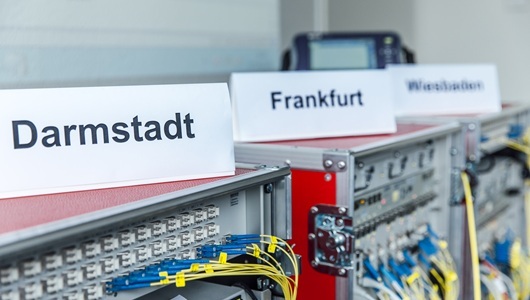
For us, prestaging isn’t just a “nice-to-have", it’s a must. In specially equipped rooms (ESD-protected, dedicated flooring, dedicated tools), we check:
Has all the hardware been delivered?
Is it working? Really?
Are the software versions and configurations correct?
Are the optical components clean?
Each device is connected and configured according to the job specifications. By the time we arrive at the customer’s site, we know the solution is up and running. This saves time and stress, and reduces space- and time-consuming situations in the data centers themselves.
3. Cleaning optical fibers
We clean every single fiber optic cable. And no, that’s not an exaggeration. Because there are many connection points along the path from the building’s connection point to the rack. If dirt accumulates there, it increases attenuation, and eventually no light will reach the end. That’s why the only solution is: clean, measure, and clean again. We do this using fiber scopes and fiber scrubs, which every technician here keeps in their toolbox. They aren’t cheap, and cleaning them obviously takes time, which is why many companies don’t bother. We do, because clean optics are half the battle when it comes to stability.
4. Measure, measure, measure
Measurements are very important because fiber-optic cables are often supplied by different vendors in Germany, with variations in quality and, in some cases, differences in length. During our measurements, we often find that the connection is not continuous from point A to point B or that the attenuation is too high.
That is why we equip each service team with multiple measuring devices. This allows us to thoroughly inspect every section of the route and remain flexible in case measurements need to be taken at different points on short notice or if a device malfunctions.
Our measuring instruments are calibrated regularly and are suitable for a variety of applications, such as testing attenuation, length, reflections, and continuity.
5. dacoso Check-up
We regularly visit our customers in person, regardless of whether an issue has been reported. This is because most service issues don’t arise suddenly - they usually show signs beforehand. That’s why we continuously monitor signal levels, attenuation, ports, optics, and software versions. Our goal is to ensure that customers don’t have to call us in the first place.
During each visit, we also check the organization of the cabinets, the filter mats, and for any physical damagee, such as that caused by outside contractors. Once a year, we provide a detailed report: What did we notice? Where are potential problems? What should be replaced?
6. Spare parts right at your fingertips
Our spare parts are not stored centrally in a large high-bay warehouse, but rather where our technicians live and work. In total, we have eleven decentralized warehouses in Germany, Austria, and Switzerland. This means that when a customer needs a spare part, it doesn’t have to be requested from a distant central location and shipped across the country. Instead, it’s available at the local warehouse, which the technician can reach quickly. He may even have key parts on hand at home. This ensures that we can resolve malfunctions or outages immediately and efficiently, even at night and on weekends.
Our service is a little different
As the saying goes, you can’t make something out of nothing. Optical connections and data center networks are at the heart of IT infrastructure and are extremely important, so we treat them accordingly. That means taking a closer look, measuring accurately, and erring on the side of caution. Over time, this has resulted in a process that isn’t necessarily the most convenient, but one that has proven its worth. The effort involved is significant, no question about it. It’s a lot of work, no question about it. But in the end, everything runs smoothly for the customer - and that’s what it’s all about.
Thomas leads the dacoso service team and has been a seasoned professional in network operations for many years. He approaches service from the perspective of the rack, not the desk, and generally prefers to rely on measurement tools rather than guesswork. With this approach, he shapes the way service is delivered at dacoso. Under his leadership, approximately 80 service technicians throughout the DACH region ensure that networks run smoothly, issues are thoroughly analyzed, and solutions are implemented in a sustainable manner.