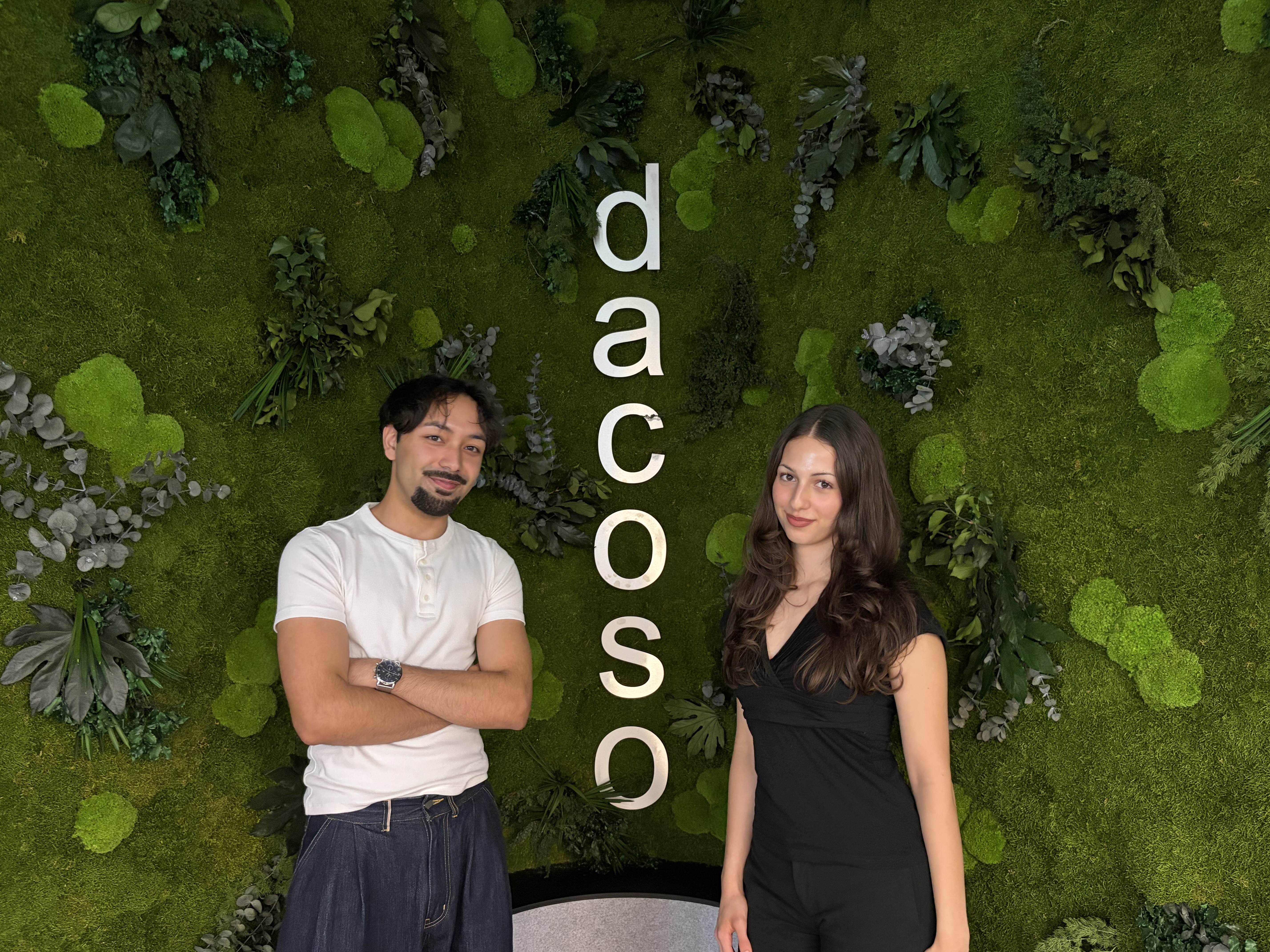
In this article, our IT apprentices Ela Hülya Agül (application development) and Yunus Nazari (systems integration) share what their training at dacoso is like. They talk about having the freedom to explore rather than following rigid instructions, a playground for experimenting, and an open approach to making mistakes. They also explain how their specializations differ and share their perspectives on the future role of artificial intelligence in everyday working life.
Ela has just started her apprenticeship in application development, while Yunus is already in his second year of training in systems integration. Both share their personal stories: how they found their way into IT and what excites them about modern technology. When it comes to artificial intelligence, they agree: “We work with AI, not against it.”
Setting in at your own pace, growing step by step
Ela and Yunus had a relaxed start as they joined the team. Their colleagues are happy to answer questions and take the time to explain how things fit together in a clear, accessible way. This gives Ela the chance to observe, make sense of new impressions, and build her knowledge before taking on her first tasks independently.
No one is expected to know how to do everything from day one. What matters is curiosity, openness, and a willingness to explore new topics. Especially in IT, where complex tasks and new technologies are part of everyday work, learning takes time and dependable support. At dacoso, the focus is therefore not on getting everything perfect right away, but on providing a solid foundation that apprentices can build on step by step.
“No one is constantly looking over your shoulder, and that’s exactly what builds trust.” (Yunus Nazari)
At dacoso, working independently and trust go hand in hand from the very beginning. No one is constantly looking over your shoulder, checking every keystroke. Our apprentices have the freedom to tackle tasks independently, take responsibility, and develop their own working style.
Clear goals provide direction, rather than a rigid set of steps to follow. What matters is finding a good solution. Working out how to get there is part of the training. This helps apprentices build not only their technical knowledge, but also confidence in their own thinking and actions.
For some, this independence feels unfamiliar at first; for others, it comes as a relief. Both reactions are perfectly fine. Having freedom does not mean being left on your own: anyone who has questions or gets stuck can always count on support from their colleagues.
Learning in different ways, moving forward together
People learn in different ways, focus on different areas, and progress at their own pace. This diversity makes teams strong: bringing together different perspectives and approaches allows them to look at tasks from several angles and find suitable solutions together.
Especially in IT, there is often more than one way to reach a goal. If the first approach does not work, it helps to try other methods, adjust the design, or look at the task in a new way. This is just as much a part of learning as gaining technical knowledge.
Learning early on how to handle difficulties in this way makes it easier to approach new challenges with confidence. An error message no longer means you have failed. Instead, it offers a clue about what is not yet working and where to take the next step.
A playground for testing, understanding, and moving forward
Yunus highlights an important part of his training: at dacoso, there is a safe environment for experimenting, testing systems, and gaining hands-on experience. In this playground, apprentices can put their ideas into practice rather than simply following a prescribed set of steps. Whether in programming or systems engineering, trying things out for themselves helps them better understand how things fit together and deepen their knowledge.
Tutorials, videos, technical documentation, and AI tools support this process. The role AI plays in learning is reflected in theDeveloper-Survey von Stack Overflow 2025 which gathered responses from more than 49,000 participants across 177 countries: 84 percent of respondents use AI tools in their development process or plan to do so. 44 percent use them to learn to code.
Für Ela und Yunus bleibt dabei eines entscheidend: Nur zuzuschauen oder fertige Lösungen zu kopieren, reicht nicht aus. Sie wollen verstehen, wie Code funktioniert und wie Systeme aufgebaut sind. Hilfsmittel können den Weg erleichtern, ersetzen aber nicht das eigene Denken. Genau dieses Verständnis hilft ihnen, Lösungen anzupassen und neue Aufgaben selbstständig anzugehen.
Two specializations, different strengths, and excellent career prospects
Ela and Yunus have chosen different areas of focus. Ela is passionate about developing and programming applications. Yunus focuses on keeping servers, networks, and platforms running reliably. Even as AI advances, he sees systems integration as a field where human expertise will remain in demand.
A 2025 Bitkom study highlights the importance of training the next generation of skilled IT professionals: at the time, Germany faced a shortage of around 109,000 IT specialists. Of the IT professionals hired in the preceding twelve months, 37 percent had completed a dual vocational IT training program combining workplace training with vocational education. 27 percent held a relevant university degree, while another 27 percent had entered IT through a career change. (Source: Bitkom)
A solid IT apprenticeship is a proven route into the industry. Whether in application development or systems integration, both specializations offer opportunities to put individual strengths to use and continue developing alongside new technologies.
AI as an opportunity, not a threat
Does AI make young IT professionals worry about their career prospects? Yunus takes a relaxed view. For him, one thing is clear: language models can generate code, but there is more to working in IT. Application developers need to understand architectures, objects, and interfaces, and assess how everything works together. Especially when unexpected errors occur, technical expertise, critical thinking, and systematic troubleshooting are essential.
In systems integration, too, he sees how important practical skills remain. Replacing routers and switches, laying cables, or installing hardware on-site: these are not tasks a language model can perform. Alongside technological support, people are needed who work carefully, assess situations, and find suitable solutions.
Current figures support this assessment
84 percent of developers already use AI tools or plan to do so. At the same time, only 33 percent consider the results fully reliable, while 46 percent deliberately assess the outputs with a critical eye. 45 percent find debugging AI-generated code time-consuming and for 66 percent, the biggest challenge is that AI suggestions often seem almost right but contain errors in the details.
Even as AI continues to advance, 75 percent of IT professionals would still prefer to consult experienced colleagues when dealing with complex questions. Trust is not built on speed alone, but on genuine understanding. Accordingly, only 36 percent regard it as a valuable tool. (Source: Stack Overflow Developer Survey)
The picture is equally clear on the business side: 66 percent of leaders prefer to hire talent with strong practical AI skills and 71 percent favor promising early-career professionals with AI know-how. (Source: Microsoft & LinkedIn Work Trend Index 2024) At the same time, 42 percent of the companies surveyed expect AI to further increase demand for highly qualified IT professionals (Source: Bitkom)
The conclusion is clear and encouraging: artificial intelligence does not replace dedicated IT professionals. It expands their toolkit and strenghtens the skills that make IT carreers fit for the future. Those who understand the underlying mechanism and use smart tools strategically are actively helping to shape the digital future.
Reliable training as a foundation for lasting success
The labor market has seen noticeable consolidation in recent years. According to the German Economic Institute, the number of vacant IT positions fell by 26.2 percent year on year to 46,431 in 2024. For applicants, this means greater competition.
At the same time, more than 13,500 positions for qualified professionals remained unfilled. Forecasts by theIW Colognesuggest that the skills shortage could return to record levels by 2028.
In addition, around 79 percent of businesses still expect shortages, while the nationwide supply of new apprenticeship contracts fell by 2.1 percent in 2025, according to theBIBB.
Against this backdrop, dacoso continues to invest in young talent. We train the next generation of IT professionals in-house in both specializations, provide targeted support to develop individual strengths, and retain dedicated people within our company for the long term. For us, apprenticeships are not a side issue, but an important foundation for lasting success.
Discovering and developing individual strengths
Ela and Yunus look forward to the many opportunities to specialize after completing their apprenticeships. For now, they are exploring different areas: network structures, cloud services, and software solutions. Step by step, this helps them discover which topics suit their strengths and where they would like to deepen their knowledge.
Yunus is particularly interested in cybersecurity, incident response, and digital forensics. He is fascinated by how network security, defense strategies, and the analysis of attacks work together. This requires understanding how attackers operate, identifying risks, and taking targeted measures to secure systems. His apprenticeship at dacoso gives him the opportunity to build the technical foundations and gain practical experience in these areas.
These interests also align with developments in the labor market: according to theFuture of Jobs Report 2025 des World Economic ForumAI, big data, and networks and cybersecurity are among the skill areas expected to grow most in importance by 2030. The projected global net increase of 78 million jobs, however, refers to the labor market as a whole, not just IT.
For Ela and Yunus, the focus now is on discovering new things, experimenting, and building on their individual strengths. We are delighted to support them along the way and wish them both every success as they move forward.
Conclusion: Exploring new possibilities with curiosity and trust
Ela and Yunus show what matters in their IT apprenticeships: tackling tasks independently, trying out their own solutions, and understanding how technology works. They approach AI with openness and a commitment to using its capabilities thoughtfully.
Three key takeaways from the conversation:
1. Trust gives people the confidence to experiment. Freedom, support, and an open approach to mistakes help them grow both professionally and personally.
2. AI offers support, but independent thinking remains essential. Assessing results and using them effectively requires technical understanding and a critical eye.
3. Hands-on training opens up a wide range of opportunities. It lays the foundations for discovering individual strengths and choosing a specialization later on.
Thank you to Ela and Yunus for sharing their experiences so openly and for their enthusiasm for learning. We look forward to supporting them as they continue their journey at dacoso.
CarlaBreidenstein is Manager Marketing & Communication at dacoso. She is responsible for marketing strategy and execution, with the aim of making dacoso’s services and expertise visible and easy to understand. She places particular emphasis on presenting complex technology and cybersecurity topics in an accessible, practical way.
Headline
Add content here.
Leyla Hercules, Working Student Marketing, dacoso
Leyla Hercules is a working student in marketing at dacoso, focusing on social media and web content. She supports the planning, creation, and publication of posts, help manage community interactions, and keep website content up to date. Working closely with the marketing team and colleagues across the company, she turns company topics into engaging content for dacoso’s digital channels and contribute fresh ideas to editorial planning.